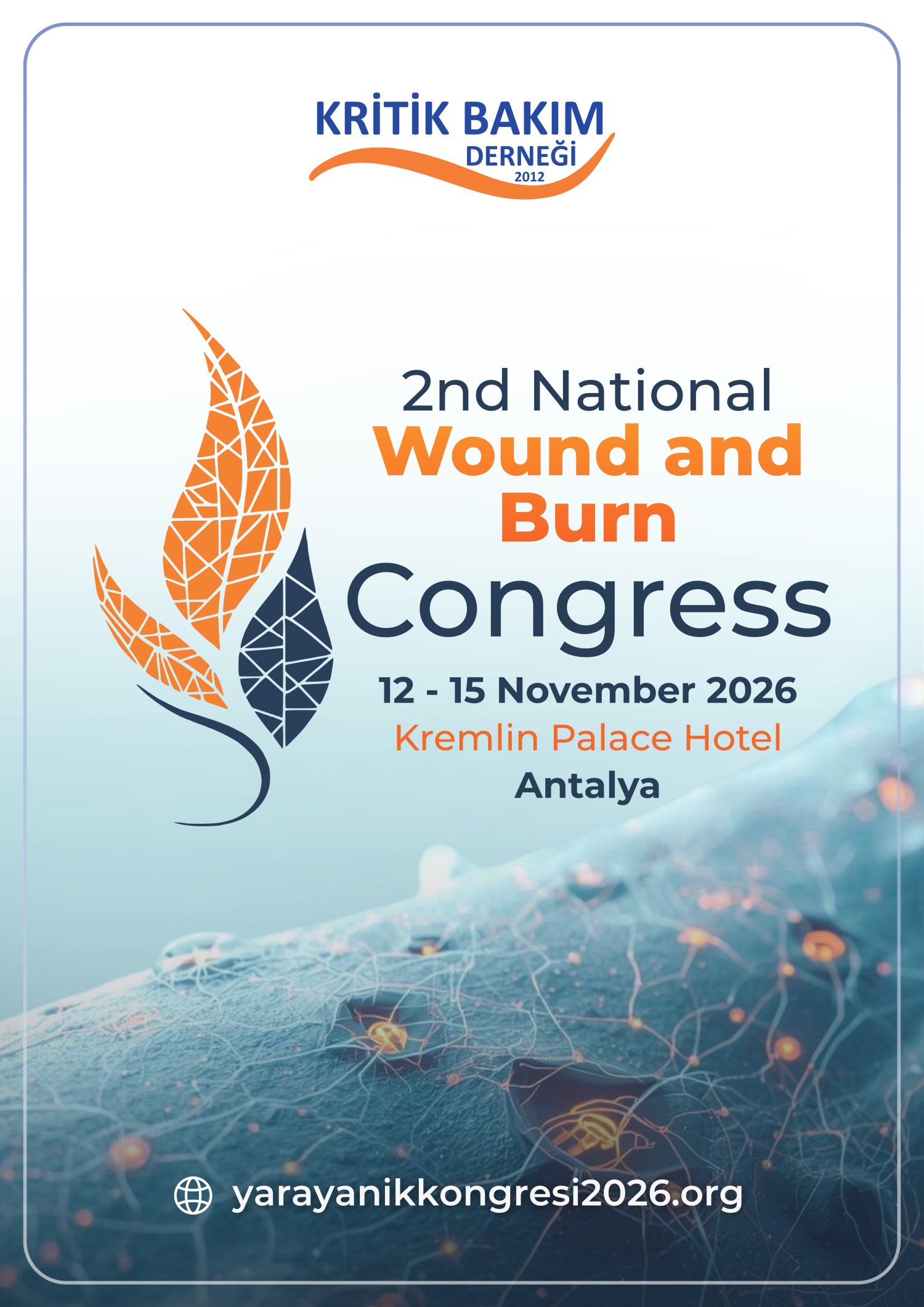
2nd Wound and Burn Congress

Kremlin Palace, Antalya

12–15 November 2026 | Time: 09:00
00
Days
00
Hours
00
Minutes
00
Seconds
Kongre Daveti

Wound and Burn Congress Invitation

Congress Invitation

Dear Healthcare Professionals,

We are coming together once again in the fields of burn care and chronic wound management, areas that often remain in the background of medicine yet stand at the very center of human life.

Following the “Wound–Burn Symposium” held in 2023 under the leadership of Ahmet Çınar Yastı, we are pleased to share our excitement in organizing the second Wound–Burn Congress in Antalya in 2026.

Throughout this congress, we will address a broad spectrum of topics ranging from clinical experience to academic research, from emerging therapeutic approaches to the organization and delivery of healthcare services, thereby bringing our knowledge, experience, and visions into meaningful dialogue.

It will be an honor to welcome all physicians, nurses, physiotherapists, and all stakeholders devoted to burn and wound care and contributing to this field.

We look forward to welcoming you to this distinguished event where science, dedicated effort, and professional solidarity converge.

We look forward to meeting you at the congress.

Sincerely,

On behalf of the Organizing Committee

Main Topics

Where Are We in Wound Care, and Where Are We Heading?
Pressure Injuries: How Can We Prevent and Manage Them?
Pressure Injury Management in Home and Palliative Care
Wound Management in Primary Health Care
Diabetic Foot Management: From Traditional Approaches to the Future
A Major Challenge from Diagnosis to Treatment: Osteomyelitis
Innovative Strategies in Wound Care and Treatment: From Theory to Practice
Peripheral Vascular Assessment: How Should It Be Performed and Managed?
Current Developments in the Treatment of Venous Leg Ulcers
A Challenge of Our Time: The Relationship Between Obesity and Wound Healing
Surgical and Non-Surgical Management of Biofilm
Rational Antimicrobial Therapy: How Will We Assess Infection Resolution?
The Role of Antiseptic Solutions in Chronic Wounds and Burns
Treatment and Care in Pediatric Wounds
Cell-Based Therapies and Beyond
The Role of Artificial Intelligence in Chronic Wound Management
AI-Based Burn Management
Stoma Care: On the Ward, in the Outpatient Clinic, at Home…
The Role of Standards and Guidelines in Wound Care: Implementation and Regulation
The Importance of Nutrition in the Wound Management Process
Innovations Offered by the Industry
Uncommon but Challenging-to-Treat Wounds
What Needs to Be Done in Wound Management Education
Chronic Wounds in the Geriatric Population: Challenges and Solutions
The Impact of a Multidisciplinary Approach on Clinical Outcomes
Advanced Plastic Surgery Techniques in the Treatment of Chronic Wounds
Physiotherapy Interventions to Support Wound Healing

Committees

Our esteemed academic committee contributing to the event

Murat Kendirci

Perçin Karakol

Ahmet Deniz Uçar Ayişe Karadağ Bengüsu Mirasoğlu Bülent Ertuğrul Çağrı Uysal Çetin Kaymak Derya Karakaya Emre Özker Filiz Öğce H. Erhan Güven Hüseyin Can Kerim Bora Yılmaz Koray Daş Murat Koç Mustafa Turan Neşe Saltoğlu Orhan Koç Recep Pekcici Selcan Abaylı Semih Bağhaki Şamil Aktaş Zehra Göçmen Baykara

Ahmet Demir Ahmet Deniz Uçar Ali Acar Ali Bolat Alper Şener Akın Karagözoğlu Arzu İlçe Arzu Karabağ Aydın Ayten Kadanalı Ayça Aytar Ayişe Karadağ Azize Karahan Barçın Öztürk Bayram Çolak Bengüsu Mirasoğlu Bülent Ertuğrul Çağrı Uysal Çetin Kaymak Derya Yapar Ece Yazla Emel Gülnar Emre Kaymakçı Emre Özker Fatma Aybala Altay Filiz Öğce Gamze Akbulut Güvenç Doğan Hakan Yiğitbaş H. Erhan Güven Hülya Bulut Hüseyin Can İbrahim Tayfun Şahiner İlke Keser İsmail Sezikli İsmail Toygar Kerim Bora Yılmaz Koray Daş Lercan Aslan Levent Altınay Levent Oğuzkurt Meryem Kılıç Metin Yalçın Murat Akın Murat Ali Çınar Murat Koç Mustafa Turan Necmiye Ün Neşe Saltoğlu Orhan Koç Ozan Barış Namdaroğlu Özge Turan Özgür Yağan Özlem Bilik Öznur Ak Recep Pekcici Selcan Abaylı Selçuk Kayır Serap Ulusoy Serhan Sakarya Sevilay Şenol Çelik Semih Bağhaki Şamil Aktaş Şenay Gül Tevfik Güzelbey Tezel Yıldırım Tülay Başak Ülkü Güneş

Scientific Program

Special sessions and talks for each day

09:00 - 12:00
Registration
12:00 - 13:30
Salon A
Tissue Integrity and Risk Management Course
Ayişe Karadağ, Derya Karakaya
Salon B
Basic Wound Dressing Techniques Course
Bengüsu Mirasoğlu, Hüseyin Can
Salon C
Debridement Techniques Course
H. Erhan Güven, İsmail Sezikli
13:30 - 14:20
Salon A
Chronic Wound Patient: How Will I Manage Them?
Ayişe Karadağ, Orhan Koç
Diabetic Foot
Murat Aksoy
Vascular Ulcer
Emre Özker
Pressure Ulcer
Recep Pekcici
The Effect of the Multidisciplinary Approach on Clinical Outcomes
Ali Cihat Yıldırım
Salon B
Triage of the Burn Patient: What Should Be Done and Common Mistakes Made
Çağatay Demirci, Ahmet Deniz Uçar
Adult Patient
Ahmet Mücteba Öztürk
Pediatric Patient
Çağatay Evrim Afşarlar
Which Patient Will I Admit, and How Will I Refer Them
Nadire Dinç
Selected Abstracts
14:20 - 14:30
Cafe Break
☕️
14:30 - 15:20
Salon A
Is Pressure Injury Inevitable?
Zehra Göçmen Baykara, Filiz Öğce
Can We Detect It Early? Are There New Technologies?
Mehmet Kubat
Challenges of Offloading in Pressure Injuries
Arzu Özcan İlçe
When Is Surgery Needed, Which Method
Serap Ulusoy
The Effect of Nutrition on Wound Healing
Samet Şahin
Selected Abstracts
Salon B
Burn Patient Resuscitation
Mustafa Turan, Hakan Yiğitbaş
Initial Intervention and in the Emergency Department
Metin Yalçın
Adult Patient in the Ward
Çağatay Demirci
Pediatric Patient in the Ward
Tuğba Eşberk
Burn Patient in the Intensive Care Unit
Evrim Beken Özdemir
Selected Abstracts
15:20 - 15:30
Cafe Break
☕️
15:30 - 16:20
Salon A
Pressure Injury Management in Home and Palliative Care
Arzu Özcan İlçe, Hüseyin Can
At Home
Bahadır Yazıcıoğlu
In the Family Health Center
Hüseyin Can
In the Palliative Care Unit
Özgür Enginyurt
In the Intensive Care Unit
Selçuk Kayır
Selected Abstracts
Salon B
Persistent Problems of the Diabetic Foot Patient
Murat Koç, Arife Düzgün Polat
Which Classification Should Be Used? Is a New Classification Needed?
Alkan Küçük
Is Prevention and Recurrence Avoidance Possible?
Uğur Kılınç
How Should Follow-Up Be Conducted After Discharge?
Serhat Tolga Derici
Selected Abstracts
16:20 - 17:00
Salon A
Beyond Wound Management
Savaş Bayrak, Bülent Ertuğrul
Visual Wound Analysis: Tissue Characterization from Photographs
Sertaç Ata Güler
Patient Safety and Ethical Perspectives
Semra Bülbüloğlu
A Wound Developed After Admission: What Happens Next?
Recep Pekcici
Selected Abstracts
Salon B
What Should I Use in Burn Dressings
Mustafa Turan, Nadire Dinç
Wound Dressings
Metin Yalçın
Creams, Gels, and Ointments
Yasin Canbaz
Negative Pressure Wound Therapy
Ozan Barış Namdaroğlu
Selected Abstracts
17:00 - 17:30
Cafe Break
☕️
17:30 - 18:30
Congress Opening and Conference
08:30 - 09:00
Salon A
Open Forum
Oturum Başkanı:
Emre Özker
Salon B
Oral Presentation Session 1
Ahmet Mücteba Öztürk, Ozan Barış Namdaroğlu
09:00 - 09:50
Salon A
Can Vascular Ulcers Be Treated?
Emre Özker, Murat Aksoy
Evaluation and Treatment of Ischemia
Selim Aydın
Treatment of Lymphedema-Associated Wounds
Pınar Borman
Interventional Treatments in Venous Diseases
Burçak Gümüş
Timing of Revascularization and Selection of Method
Selim Aydın
Salon B
Anesthesia for Burn Patients
Çağatay Evrim Afşarlar, Özgür Yağan
In the Intensive Care Unit
Evrim Beken Özdemir
In the Operating Room
Özgür Yağan
In Pediatric Patients
Ümit Kara
Pain Management
Güvenç Doğan
Selected Abstracts
09:50 - 10:00
Cafe Break
☕️
10:00 - 10:50
Salon A
The Diabetic Foot Is Not Just a Wound
Seher Demirer, Ahmet Deniz Uçar
Diabetic Foot and Psychology; Patient, Family Member, Healthcare Professional
Duygu Hiçdurmaz
Physiotherapy for Diabetic Foot Ulcers: When, How, and How Much?
Tezel Yıldırım Şahan
Offloading Methods: How Do I Apply Them?
Merve Güner Çayırlı
How Should We Nutritionally Manage the Diabetic Foot Patient?
Çetin Kaymak
Selected Abstracts
Salon B
Infection Control in Burns
Koray Daş, Bülent Ertuğrul
The Role of Antiseptics and the Threshold of Cytotoxicity
Serhan Sakarya
Should I Give Antibiotics to Every Burn Patient?
Nur Benzonana
Should We Use Topical Agents for Infection Prevention?
Derya Yapar
Selected Abstracts
10:50 - 11:20
Salon A
Vascular Assessment Course
Murat Koç, Ali Bolat
Salon B
Dermatome Usage Course
Ahmet Deniz Uçar, Koray Daş
Salon C
Wound Culture Sampling and Evaluation Course
Neşe Saltoğlu, Alper Şener
11:20 - 11:40
Cafe Break
☕️
11:40 - 12:30
Salon A
Satellite Symposium 1
No talk information entered for this session.
Salon B
Oral Presentation Session 2
Nadire Dinç, İsmail Sezikli
12:30 - 13:30
Lunch
13:30 - 14:20
Salon A
Satellite Symposium 2
No talk information entered for this session.
Salon B
Oral Presentation Session 3
Alkan Küçük, Uğur Kılınç Session Chair
14:20 - 14:40
Cafe Break
☕️
14:40 - 15:30
Salon A
Satellite Symposium 3
No talk information entered for this session.
Salon B
Oral Presentation Session 4
İlker Kızıloğlu, Derya Yapar
15:30 - 15:40
Coffee Break
☕️
15:40 - 16:30
Salon A
Chronic Wound Treatment – Debridement, but How?
İbrahim Tayfun Şahiner, Kerim Bora Yılmaz
Enzymatic and Chemical Debridement
H. Erhan Güven
Mechanical and Sharp Debridement
Fatih Yanar
Ultrasonic Debridement
Serap Ulusoy
Hydrosurgery
İsmail Sezikli
Selected Abstracts
Salon B
Wound Care Products
Bayram Çolak, Savaş Bayrak
How Do I Obtain Wound Care Products?
Ahmet Deniz Uçar
What Should I Consider When Selecting Products?
Emre Özker
Selected Abstracts
16:30 - 16:50
Coffee Break
☕️
16:50 - 17:40
Salon A
AI-Supported Future in Wound Management
Ahmet Serdar Karaca, Murat Akın
Smart Assessment in Chronic Wounds: From Photography to Treatment Planning
İbrahim Tayfun Şahiner
Artificial Intelligence in Stoma Care: The Patient’s Silent Consultant at Home
Ömer Faik Ersoy
Artificial Intelligence in Burn Care: Next-Generation Decision Support for Depth, Surface Area, and Triage
Metin Kement
AI-Supported Wound Clinic: A Dream or the Near Future?
Ala Elcircevi
Salon B
Chronic Wound Management Guidelines and Algorithm Development Studies
Savaş Bayrak
Açık Mikrofon
17:40 - 18:30
Salon A
Adjunctive Therapies in Chronic Wound Treatment
Şamil Aktaş, Bayram Çolak
Is Hyperbaric Oxygen Therapy Beneficial for Every Wound?
Bengüsu Mirasoğlu
Do Oxygen Therapies Offer Hope? : Topical O₂ – Ozone
Alkan Küçük
Wound Treatments from Nature’s “Medicine Cabinet”: Larvae – Leech – Honey
Onur Öztürk
Collagen, Hyaluronic Acid, Amino Acids
Serhat Tolga Derici
Current Endovascular Interventions
Sadık Ahmet Uyanık
Salon B
Roadmap for the Future of Chronic Wound Management
Ayten Kadanalı, Hikmet Erhan Güven
Successful Organizational Models from Around the World
Ayişe Karadağ
What Is the Situation in Our Country, and What Should It Be Like?
Selcan Abaylı
Remote Patient Management – Telemedicine
Savaş Bayrak
Patient and Family Education: Wound Care School
Yusuf Yavuz
08:30 - 09:00
Salon A
Open Forum
Oturum Başkanı:
Alper Şener
Salon B
Oral Presentation Session 5
Barçın Öztürk, Serhat Tolga Derici
09:00 - 09:50
Salon A
Infection Management in Chronic Wounds
Ayten Kadanalı, Alper Şener
To Whom, When, and Which Antibiotic Should We Use? Is IV Therapy Mandatory, or Is Oral Treatment Sufficient?
Neşe Saltoğlu
How and When Do We Determine Whether the Infection Has Resolved? Will Treatment Durations Be Shortened?
Barçın Öztürk
Are Antiseptic Solutions Necessary?
Derya Yapar
What Are the Limits of Topical Antimicrobial Use?
Alper Şener
Selected Abstracts
Salon B
Rare but Challenging Wounds
Mehmet Ali Gülçelik, Semih Bağhaki
Epidermolysis Bullosa: Who Will Manage It and How?
Filiz Cebeci Kahraman
Incontinence-Associated Dermatitis
Emine Sezgünsay
Vasculitic Ulcers: Difficult to Recognize, Difficult to Manage
Emre Özker
Non-Healing Wounds and Skin Cancers: Two Sides of the Same Coin
Semih Bağhaki
How Do I Manage a Malignant Wound?
Kerim Bora Yılmaz
09:50 - 10:10
Coffee Break
☕️
10:10 - 11:00
Salon A
Diabetic Foot Surgery: How I Do It – Video Session
Perçin Karakol, Kerim Bora Yılmaz
Diabetic Emergencies
İsmail Sezikli
Amputations
Ali Özyalçın
Grafts
Berrak Karatan
Fleps
Ahmet Demir
Advanced Plastic Surgery Approaches: Free Tissue Transfers
Semih Bağhaki
Salon B
How Should We Manage Stoma-Related Complications?
Ayhan Bülent Erkek, Ahmet Serdar Karaca
Ostomy-Related Wounds and Their Management
Aysel Ören Hin
Errors in Ostomy Care and Their Management
Serpil Uçar
Nutrition in Patients with an Ostomy
Erdinç Çetinkaya
Challenges of Daily Living with an Ostomy
Gözde Türkmenoğlu Küçükakça
Psychological Well-Being of Patients with an Ostomy
Duygu Hiçdurmaz
11:00 - 11:30
Salon A
Stoma Care Course
Zehra Göçmen Baykara, Erdinç Çetinkaya
Salon B
Negative Pressure Wound Therapy Course
Kerim Bora Yılmaz, Bayram Çolak
Salon C
Compression Therapy Course
Emre Özker, Alper Erkin
11:20 - 11:40
Coffee Break
☕️
11:40 - 12:30
Salon A
Satellite Symposium 4
No talk information entered for this session.
Salon B
Oral Presentation Session 6
Uğur Kılınç, Aysel Ören Hin
12:30 - 13:30
Lunch
13:30 - 14:20
Salon A
Satellite Symposium 5
No talk information entered for this session.
Salon B
Oral Presentation Session 7
Ali Cihat Yıldırım, Semra Bülbüloğlu
14:20 - 14:30
Coffee Break
☕️
14:30 - 15:20
Salon A
Satellite Symposium 6
No talk information entered for this session.
Salon B
Oral Presentation Session 8
Güvenç Doğan, Serpil Uçar
15:20 - 15:40
Coffee Break
☕️
15:40 - 16:30
Salon A
Advanced Techniques in Chronic Wound Management
Semih Bağhaki, H. Erhan Güven
Tissue Engineering and Legal Regulations
Koray Daş
Growth Factors
Çağrı Uysal
Skin Equivalents and Dermal Scaffolds
Perçin Karakol
Exosome and Stem Cell Applications
Kerim Bora Yılmaz
Salon B
Both the Wound Is Difficult and the Patient Is Difficult: What Should We Do, How Should We Do It?
Yusuf Yavuz, Murat Akın
Immunosuppressed Patient
Ozan Barış Namdaroğlu
Pregnant Patient
Hakan Yiğitbaş
Septic Patient
Bayram Çolak
Very Elderly Patient
İlker Kızıloğlu
In the Context of Pediatric Patients
Çağatay Evrim Afşarlar
16:30 - 16:50
Coffee Break
☕️
16:50 - 17:40
Salon A
Wound Treatment Under Extraordinary Conditions
Neşe Saltoğlu, Orhan Koç
Wound Management in War Zones
Baki Türkoğlu
Challenges During Disasters
Ali İşler
What Did We Experience During the Pandemic?
İlker Akdeniz
Selected Abstracts
Salon B
Burn Surgery: When and How?
Ahmet Deniz Uçar, Koray Daş
Escharotomy, Escharectomy, Fasciotomy
Hakan Yiğitbaş
Early Fascial Excision and Grafting Application
Mustafa Turan
What Should We Pay Attention to in Postoperative Care?
Gamze Özer Özlü
Problems Encountered in Pediatric Patients
Ebru Abalı
17:40 - 18:30
Salon A
What Do Associations Do for Wound Management? The Activities and Recommendations of Associations Supporting the Congress on Wound Management
Murat Kendirci
TYOİHD
Zehra Göçmen Baykara
TCD
Ahmet Deniz Uçar
TKRCD
Murat Kendirci
Sualtı ve Hiperbarik Tıp Derneği
Bengüsu Mirasoğlu
KLİMİK
Ayten Kadanalı
Aile Hekimleri Derneği
Hüseyin Can
UVECD
Emre Özker
EPCD
Ahmet Demir
Salon B
How Should We Feed Burn Patients?
Seher Demirer, Çetin Kaymak
Adult Patient
Samet Şahin
Pediatric Patient
Tuğba Eşberk
After Discharge
Gülsüm Tozlu Bindal
Selected Abstracts
08:30 - 09:00
Salon A
Open Forum
Oturum Başkanı:
Ahmet Deniz Uçar
Salon B
Oral Presentation Session 9
Hüseyin Can, Gülsüm Tozlu Bindal
Salon C
Oral Presentation Session 10
Yasin Canbaz, Ozan Barış Namdaroğlu
09:00 - 10:00
Salon A
Unresolved Issues in Diabetic Foot Infections
Serhan Sakarya, Bülent Ertuğrul
Is Biofilm a Real Problem or Irrelevant? What Are the Preventive Strategies?
Alper Şener
Anti-Biofilm Products
Serhan Sakarya
Surgical Management of Biofilm
H. Erhan Güven
Osteomyelitis Remains a Problem—What Should We Do?
Bülent Ertuğrul
Selected Abstracts
Salon B
Advanced Burn Wound Management
Mustafa Turan, Ahmet Demir
Scar and Contracture Management
Perçin Karakol
Use of Skin Substitutes
Koray Daş
Use of Dermal Scaffolds
Ahmet Deniz Uçar
Stem Cell Applications
Çağrı Uysal
10:00 - 10:20
Coffee Break
☕️
10:20 - 11:20
Salon A
Local Treatment of Chronic Wounds – Dressings
Hüseyin Can, H. Erhan Güven
Effective Use of Wound Dressings
Derya Karakaya
Creams, Gels, and Ointments
Emre Özker
Negative Pressure Wound Therapy
Bayram Çolak
Selected Abstracts
Salon B
Problems of the Wound Care Community
Ayişe Karadağ, Neşe Saltoğlu
From a Physician’s Perspective
Şamil Aktaş
From a Nurse’s Perspective
Zehra Göçmen Baykara
From an Industry Perspective
Mehmet Alçev
11:20 - 11:40
Kahve Molası
☕️
11:40 - 12:30
Salon A
Barriers to Chronic Wound Healing
Kerim Bora Yılmaz, Bayram Çolak
Common and Difficult Problem: Callus and Its Treatment
Uğur Kılınç
Where Does Podiatry Stand in Our Country, and What Should Be Done?
Merve Güner Çayırlı
Pain Management in Chronic Wounds
Güvenç Doğan
A Barrier Complicating Surgery: Anesthesia in the Chronic Wound Patient
Selçuk Kayır
Salon B
Final Remarks: Recommendations for Future Scientific Activities (Open Microphone)
Perçin Karakol
12:30 - 13:00
Salon A
Closing and Award Ceremony
No talk information entered for this session.

Workshops

You can find the workshop program by day below.

A workshop schedule has not yet been announced for this event.

Courses

You can register by selecting one of the courses or competitions below. Your first course selection in this event is free!

Kurs afişi
Current Approaches and Risk Management in Preserving Tissue Integrity

12 November 2026

Kurs Coordinators:
Prof. Dr. Ayişe Karadağ
Stoma and Wound Care Nurse Derya Karakaya

Target Audience

All healthcare professionals working in the fields of skin and tissue integrity preservation and wound management.

Course Objectives

By the end of the course, participants will be able to:

  • Identify risk factors that threaten tissue integrity.

  • Explain current methods and technologies used for risk assessment.

  • Discuss evidence-based risk reduction and prevention approaches for the prevention of chronic wounds.

  • Evaluate the role of artificial intelligence and current technologies in clinical decision-making processes.

  • Interpret risk management strategies from the perspectives of patient safety and cost-effective care.

Course Programme

Tissue Integrity Problems: Importance, Prevalence, and Patient Safety (25 min)
A. Karadağ

  • Importance of preserving tissue integrity

  • Patient safety

  • Current epidemiology

  • Pressure injuries

  • Incontinence-associated dermatitis

  • Skin tears

  • Diabetes-related foot disease

  • Arterial and venous ulcers

Learning Through Fun: Tissue Integrity Problems: Importance, Prevalence, and Patient Safety (5 min)

New Technologies in Risk Assessment (30 min)

  • Artificial intelligence-supported risk assessment systems

  • Digital wound imaging technologies

  • Mobile health applications

  • Sensor technologies

  • Smart beds and support surfaces

  • Telehealth applications

  • Digital clinical decision support systems

Evidence-Based Approaches to Preserving Tissue Integrity (30 min)

  • Risk-based prevention strategies

  • Pressure redistribution

  • Microclimate management

  • Nutrition and hydration

  • Mobilization and activity management

  • Preventive dressings and interventions

  • Patient and family education

  • Cost-effective care practices

Case Workshop: What Would You Do? (30 min)

Using real-life adapted case scenarios and technology, participants will:

  • Identify risks

  • Prioritize interventions

  • Decide whether and how to use technology

  • Develop a prevention plan

  • Discuss their clinical decisions

Kurs afişi
Compression Therapy Practices

14 November 2026

Kurs afişi
Use of the Ankle–Brachial Index (ABI) and Handheld Doppler in Lower-Extremity Vascular Assessment

13 November 2026

Kurs afişi
Negative Pressure Wound Therapy

14 November 2026

Kurs afişi
A Holistic Approach in Individuals with a Stoma and the Management of Peristomal Complications

14 November 2026

Kurs afişi
Fundamental Dressing Techniques and Product Selection

12 November 2026

Kurs afişi
Debridement Techniques

12 November 2026

Kurs afişi
Wound Culture Collection and Interpretation of Results

13 November 2026

Kurs afişi
Use of a Dermatome in Burn Surgery

13 November 2026

To register for courses, please log in.

Abstract Submission

Share your scientific work with our community. You can start the evaluation process by filling out the form below.

Submission Guidelines

THIS CONGRESS IS A PEER-REVIEWED EVENT.

ABSTRACT SUBMISSION IS NOW OPEN

The 2nd National Wound and Burn Congress will be held in Antalya, Türkiye, on 12–15 November 2026.

Abstract submissions are now being accepted. Accepted abstracts may be presented as face-to-face oral or poster presentations.

Detailed abstract submission guidelines are provided below.

Prepared Oral and Poster Abstracts should be uploaded via the "Submit Abstract" section available on the congress website.

Abstract Submission Deadline: 31 August 2026, 17:00 (Turkey Time)

Those whose abstracts have been accepted may contact the Congress Secretariat after the date of abstract acceptance and until 2 October 2026 in order to benefit from the early registration fee.

All accepted abstracts will be presented between 12–15 November 2026. The presentation schedule will be announced prior to the congress.

ORAL PRESENTATION GUIDELINES

• Congress abstracts may cover all scientific studies related to wound and burn care and management.

• All accepted abstracts will be presented orally during the congress.

• Oral presentations will be delivered in designated halls at the Kremlin Palace during the congress dates.

• Presentation schedules will be published on the Scientific Programme page following the announcement of accepted abstracts.

• All abstract submissions must be made through the Online Abstract Submission System available on the congress website.

• Only abstract texts will be accepted, and the abstracts presented at the congress will be published in the ISBN-registered Abstract Book.

• Abstracts must be prepared in both Turkish and English in accordance with the Abstract Template. Both the Turkish and English texts must fully comply with grammar, spelling, and language quality standards. Abstracts that fail to meet these requirements or for which the requested revisions are not completed will not be accepted.

• If accepted, oral presentations will be delivered in Turkish.

• Participants who wish to submit more than two abstracts to the Congress are required to send their abstracts to the e-mail address provided in the Contact section.

• Abstract acceptance will be determined through peer review. Corresponding authors will be notified of the review results by e-mail.

• When uploading the abstract, the file name must follow the format: name-surname-yara2026.

• Files must be uploaded in Microsoft Word format.

• All submissions must use Times New Roman, 12-point font, single line spacing, and justified alignment.

• Registration of at least one author is mandatory for the abstract to be included in the scientific programme.

POSTER PRESENTATION GUIDELINES

• Posters must be prepared as a single panel measuring 70 × 100 cm.

• The poster title must be written entirely in uppercase letters, in bold, using a font size between 44 and 50 points.

• A margin of 2 cm must be left on the top, bottom, left, and right sides.

• Author name(s) must be written in bold, using a font size between 24 and 36 points.

• Author e-mail address(es) must be written in a font size between 20 and 28 points. The name of the presenting author must be underlined.

• The main poster text must be written using a font size between 22 and 32 points.

• Posters must be prepared using Times New Roman font and should include the following sections:
Title, Abstract (Turkish and English), Introduction and Objective, Materials and Methods, Results, Conclusion, Recommendations, Keywords, and References.

• Appropriate line spacing may be used to improve readability.

• References should be written in 12–18 point, non-bold font.

• Posters should emphasize visual presentation through the use of graphs, tables, illustrations, figures, and photographs wherever appropriate.

• All photographs included in the poster must be of high resolution and may be used at the desired size.

• Posters will be presented on the dates and at the times announced on the congress website. Poster presenters are expected to be present beside their posters during their assigned presentation period to answer questions.

• Posters approved by the Organizing Committee will be mounted in the designated display areas by the Congress Agency. The placement of posters is the responsibility of the Agency.

• The congress logo must appear in the upper-left corner of the poster.

• Authors' institutional affiliations may be placed directly beneath the author names or as a footnote at the bottom of the poster.

• Posters will be uploaded to the congress website on the opening day of the congress.

• The deadline for poster submission is 31 August 2026 at 17:00 (Turkey Time).

MAIN TOPICS

• Where are we in wound treatment, and where are we heading?

• Pressure injuries: How can we prevent and manage them?

• Pressure injury management in home care and palliative care

• Wound management in primary healthcare services

• Diabetic foot management: From traditional approaches to the future

• Osteomyelitis: A major challenge from diagnosis to treatment

• Innovative strategies in wound care and treatment: From theory to practice

• Peripheral vascular assessment: How should it be performed and managed?

• Current developments in the treatment of venous leg ulcers

• A challenge of our era: Obesity and its relationship with wound healing

• Surgical and non-surgical management of biofilm

• Rational antimicrobial therapy: How can infection resolution be assessed?

• The role of antiseptic solutions in chronic wounds and burns

• Treatment and care of pediatric wounds

• Cell therapies and beyond

• The role of artificial intelligence in chronic wound management

• Artificial intelligence-based burn management

• Stoma care: In the ward, outpatient clinic, and home

• The role of standards and guidelines in wound care: Implementation and regulation

• The importance of nutrition in the wound management process

• Innovations offered by industry

• Rare but difficult-to-manage wounds

• Priorities in wound management education

• Chronic wounds in the geriatric population: Challenges and solutions

• The impact of a multidisciplinary approach on clinical outcomes

• Advanced plastic surgery techniques in chronic wound management

• Physiotherapy interventions supporting wound healing

To submit an abstract, please log in.

Important Dates

You can find the important dates not to be missed during the event process below.

Early Registration Deadline

31 Jul 2026

Abstract Submission Deadline

31 Aug 2026

15 Sep 2026

Deadline extended
Sponsorship Meeting (Ankara, Crowne Plaza Hotel)

06 Mar 2026

Sponsorship Meeting (İstanbul, Arts Hotel Harbiye)

12 Mar 2026

Abstract Acceptance Start Date

15 Jun 2026

Announcement of Accepted Abstracts

20 Sep 2026

Congress Start Date

12 Nov 2026

Accommodation Options

Below you will find the contracted accommodation and price information for your event.

Kremlin Palace

Kremlin Palace

Congress Venue: Kremlin Palace – Antalya

Accommodation Fees Accommodation Fees

Room Type Price:
Per Person in a Triple Room - 3 Nights (After 1 August 2026) 438.00 EUR
Per Person in a Double Room - 3 Nights (After 1 August 2026) 504.00 EUR
Single Room -3 Nights (After 1 August 2026) 792.00 EUR

Participation & Payment

To complete your event registration, you can send the participation fee to one of the accounts listed below.

Registration Fees:

Registration Type: Price:
Late Registration (After August 1, 2026) 270.90 EUR

External Participation Services

External Participation Fee Fee
Daily, Between 09:00 and 18:00 Hours 95,00 Euro + VAT

Transfer Services

Transfers One Way Round Trip
Group Transfers 30,00 Euro + KDV 60,00 Euro + VAT
Private Transfers 50,00 Euro + VAT 100,00 Euro + VAT


The registration fee is the same for Physicians, Specialists, Healthcare Professionals, and Company Representatives.

Services Included in the Registration Fee:

  • Participation in all scientific activities, certificate of attendance, congress bag, and congress materials are included in the registration fee.
  • The above prices are exclusive of 20% VAT. Any changes in the applicable tax rates will be reflected accordingly.
  • If payment is not made within the specified dates for early registration, budgets will automatically be revised based on the late registration fees.

Registration Cancellation and Refund Policy:

  • All requests and changes regarding registration reservations must be submitted in writing to the Congress Secretariat. For cancellation requests, please send an e-mail to bilgi@yarayanikkongresi2026.org.
  • Cancellations notified by 1 August 2026 will be eligible for a full refund.
  • Cancellations notified by 30 September 2026 will be eligible for a 50% refund of the amount paid.
  • No cancellations or refunds will be accepted after 30 September 2026; however, name changes will be permitted.

External Participation Information:

  • The external participation fee applies to all participants and company representatives regardless of registration type. This fee includes access to the congress venue during the scientific program and activities, lunches, and refreshments served at the congress center.
  • Participants who do not book accommodation through the congress organization and only register for participation, as well as those not staying at the congress hotel, are required to pay an additional external participation fee of 95 EUR + VAT per day to access hotel services, congress refreshments, and social events between 12–15 November 2026 from 09:00–18:00. Participants who do not pay the external participation fee will not have a valid congress registration.

Transfer Information:

  • The stated price is a per-person group transfer fee between Antalya Airport and the Kremlin Palace.
  • For private transfer requests, written communication with the congress secretariat is required.
  • All transfer fees above do not include 20% VAT. Any changes in tax rates will be reflected accordingly.
  • Transfer fees may be updated if deemed necessary by the Congress Organizing Committee.
  • Payments can be made in EUR or Turkish Lira to the specified IBAN account. For payments in Turkish Lira, the Central Bank of the Republic of Türkiye exchange rate on the transaction day will apply.

Accommodation Information

  • The package prices listed above include 3 nights of accommodation on an Ultra All-Inclusive basis between 12–15 November 2026.
  • The accommodation fees listed above are exclusive of 10% VAT and 2% Accommodation Tax. Any changes in the applicable tax rates will be reflected accordingly.
  • Hotel check-in is available from 14:00, and check-out is by 12:00. Early check-in and late check-out are subject to additional charges. The hotel is not obliged to allocate rooms outside the designated check-in and check-out hours; however, every effort will be made to accommodate participants, subject to availability. Luggage storage will be available for participants arriving early or departing late.
  • Room availability is limited, and reservations will be closed once the room allocation has reached full capacity.
  • Participants accompanied by a companion may benefit from the same accommodation rates.
  • All reservation cancellation requests must be submitted in writing to the Congress Secretariat.
  • Accommodation rates are valid for participants who register by 1 August 2026. Registrations received after 1 August 2026 will be subject to a 20% late accommodation surcharge. Participants who register within the early registration period but fail to complete their payment by 1 August 2026 will also be charged the 20% late accommodation surcharge.
  • If the applicable late accommodation fee is not paid by 29 October 2026, an additional 15% on-site accommodation surcharge will be applied.
  • Participants or sponsors who do not stay at the congress hotel and do not book their accommodation through the official congress agency will be required to pay the hotel’s external participation fee. The external participation fee is EUR 95.00 + VAT per day.
  • Accommodation Cancellation and Refund Policy
  • Any requests for accommodation changes or cancellations must be submitted in writing to the Congress Secretariat. Cancellation requests should be sent by e-mail to bilgi@ditagrup.com.
  • Cancellations received by 1 August 2026 will be eligible for a full refund.
  • Cancellations received by 30 September 2026 will be eligible for a 50% refund of the amount paid.
  • No cancellations or refunds will be accepted after 30 September 2026; however, name changes will be permitted.
  • All refunds will be processed within 30 business days after the conclusion of the congress.

Turkish Lira IBAN (₺)

IBAN Number

TR 64 0001 2001 3720 0010 1009 42

Account Holder

DİTA MEDYA PRODÜKSİYON VE DANIŞMANLIK HİZMETLERİ LTD. ŞTİ.

Contact Us

Get in touch with us for information about the event

  • Event Coordinator: Ayşe Bayam
    0 552 588 68 68
  • Organization Secretariat: Gülhan Karagöz
    0 545 450 75 06
  • Sponsorship Email
    yaraveyanik2026@gmail.com
  • Participant Mail
    bilgi@yarayanikkongresi2026.org
  • Address
    Kremlin Palace - Kundu Neighborhood, Yaşar Sobutay Boulevard, Kremlin Hotel Complex, No. 98/10, No: A Z01, Aksu/Antalya

2nd Wound and Burn Congress

A meeting point for scientific exchanges, inspiring talks, and international participants.

You can check the relevant sections of the page for event details, application, and registration information.


Need help?

Feel free to send your questions to bilgi@ditagrup.com.